On This Island
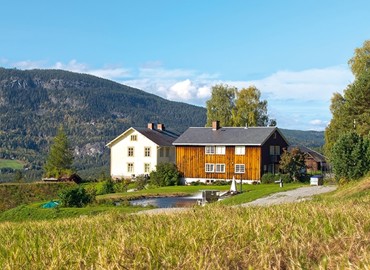
Before lunch is served at Noraker Gård, we gather four composers who explore the relationship between text, voice, and sound in different ways—from early Romanticism to 20th-century modernist expression.
Louis Spohr's Sechs deutsche Lieder (1837) represents a rare and exquisite encounter between soprano, clarinet, and piano. Spohr, one of the most renowned musical figures of his time, creates an intimate space in which the clarinet functions as an equal partner to the voice. The songs are characterized by lyrical elegance, warm timbres, and the thematic universe of Romanticism: nature, longing, and quiet emotional depth.
Rebecca Clarke's The Seal Man (1922) takes us into a completely different world – darker, more dramatic and harmonically bolder. Clarke, a pioneer among female composers in Great Britain, draws inspiration from Celtic mythology and creates an intense, psychologically charged song in which the piano forms a undulating, almost cinematic backdrop. The work stands as a powerful expression of her modern sensibility and characteristic sound world.
Fanny Mendelssohn Hensel's songs reveal a composer with a distinct personal voice, rich melodic imagination, and a dramatic nerve that ranges from the intimate to the colorfully expressive. Although she was relegated to the private sphere of music, she wrote over 250 songs that are today considered among the most expressive vocal miniatures of the Romantic period. This time, a selection of her Lieder is performed in an arrangement for clarinet and piano, which highlights the beauty of the melodies and the equal dialogue between the voices.
Benjamin Britten's song cycle On This Island (1937) marks an early high point in his output and already shows the distinctive voice that would later characterize his operas. Britten drew on five poems from W. H. Auden's collection of the same name – a collaboration that was crucial to his artistic development in the 1930s. The cycle combines the intimate and the dramatic, demonstrating Britten's ability to let the music reflect the rhythm, irony, vulnerability, and intensity of the text. As one of the most important vocal composers of the 20th century, Britten is in a class of his own when it comes to creating music in which words and tones are inextricably linked. This year marks the 50th anniversary of his death.
Together, these works form a program that ranges from the lyrical fervor of Romanticism to the psychological and tonal nuances of Modernism—a journey through the many expressions and possibilities of song.
Practical information:
- Doors open 30 minutes before the start of the event
- Guests will be served a delicious lunch including fish from Noraker farm and rakfisk after the concert.
- Parking available at Noraker Gård
Foto: Public domain, via Wikimedia Commons